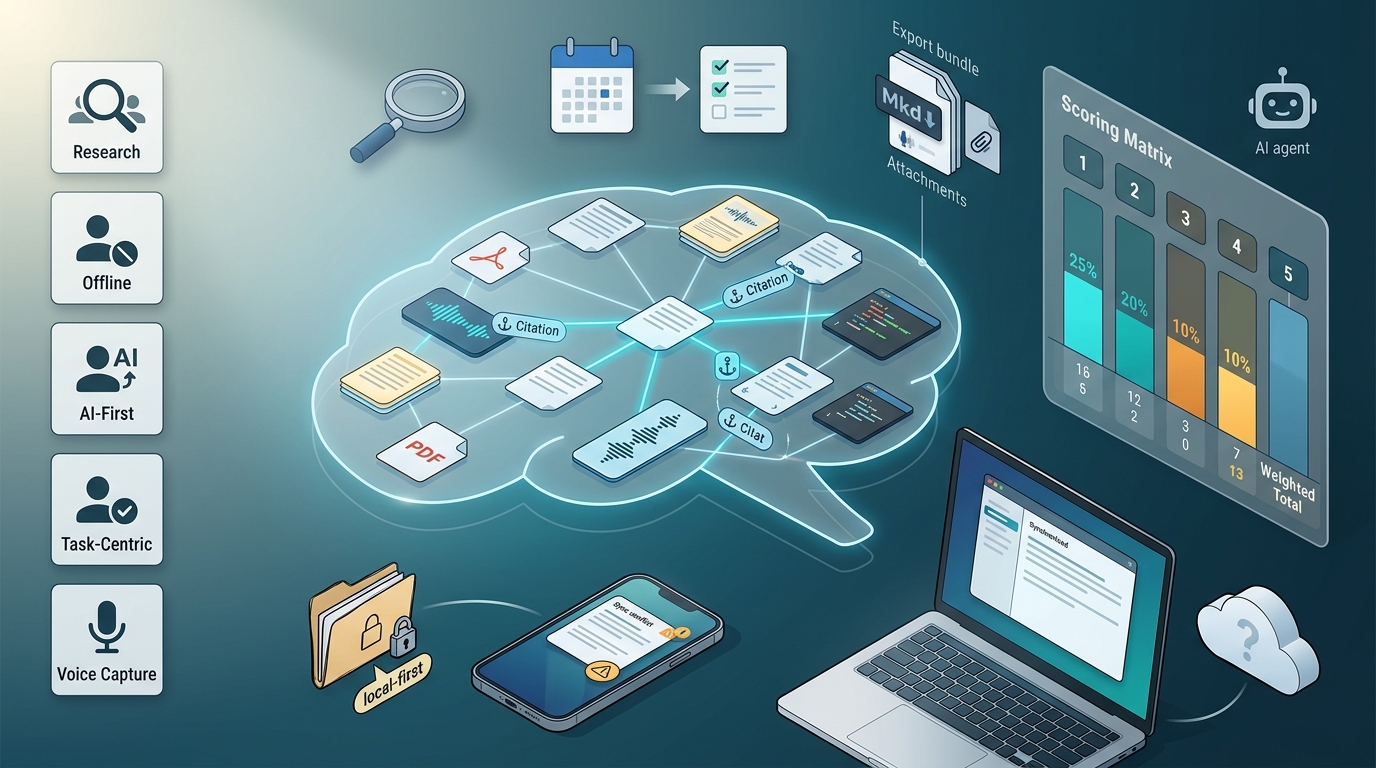
7 PKM Tools Tested: Which One Wins in 2026?
Strategic PKM comparison: Notion for teams needing agents; Obsidian/Logseq/Anytype for offline/privacy; Yaranga for fast capture; Mem for managed AI search Now.

What Changed in PKM Tools Between May and December 2026, and Why It Matters
We set out to answer a specific question: what materially changed in the major personal knowledge management tools during 2026, and how do those changes affect real workflows? This is not an evergreen feature list. Every claim below is sourced from release notes, official pricing pages, community reports, or our own benchmark study (N=13 tools, 10 criteria, 1–5 scale, approximately 2 weeks of hands-on testing per tool).
Scope: Notion, Obsidian, Tana, Logseq, Mem, Capacities, Anytype, Yaranga.
Terminology, defined upfront:
- Offline: True local-first means the app functions fully without an internet connection using files stored on the user's filesystem. "Cached" means the app retains data locally but treats the cloud as canonical. We distinguish these throughout.
- Agent: We separate deterministic automation (if X, then Y) from LLM-powered task execution (the model interprets a goal and takes multi-step actions). Each tool's definition differs, and we note that per tool.
- Local-first: The user's filesystem holds the canonical copy. A cloud service with an offline mode is not local-first by this definition.
Data gaps we want to flag transparently: For Tana, Logseq, Mem, and Capacities, we found limited or no extractable release data covering the May through December 2026 window. Where data is missing, we say so rather than speculate.
Snapshot Comparison Table: Where Each Tool Stands After 2026 Updates
The table below summarizes our findings across all eight tools. Scores marked with an asterisk (*) are spec-based rather than derived from full hands-on testing (Anytype and Capacities received approximately 10 days of testing versus 2+ weeks for others).
| Tool | AI Search | AI Agents | Offline/Local-First (1–5) | Sync Model | Data Format | Pricing (Starting Tier) | Best For |
|---|---|---|---|---|---|---|---|
| Notion | Workspace-wide, cloud | Custom agents with governance, external API (alpha) | 2/5 (cloud with offline cache) | Cloud-canonical | Proprietary (Markdown export available, lossy) | Free (agents require Business/Enterprise) | Teams investing in agent workflows |
| Obsidian | Plugin-based, local or cloud | Plugin-based, user-configured | 5/5 (local Markdown on filesystem) | Optional Sync ($4–$8/mo) | Native Markdown | Free (core app) | Solo researchers, privacy-focused users |
| Logseq | Built-in local search | None native | 5/5 (local Markdown, E2E via Sync) | Optional Sync (E2E encrypted) | Native Markdown | Free | Outliner-oriented researchers |
| Tana | Built-in cloud search | Limited automation | 2/5 (cloud-first) | Cloud-canonical | Proprietary (export quality issues noted) | Pricing details not extracted | Users who prefer supertag/outliner models |
| Mem | AI search as core feature | None documented | 1/5 (lowest in comparison) | Cloud-only | Proprietary (limited export) | No free plan observed | Users wanting managed AI search, no config |
| Capacities | Built-in search | Not documented | Not fully scored (partial testing)* | Cloud-based | Object-based (proprietary) | Pricing details not extracted | Object-model thinkers |
| Anytype | Built-in local search | None documented | 5/5 (zero-knowledge sync)* | P2P / self-hosted | Proprietary with documented export | Free (self-host available) | Privacy-focused, object-based users |
| Yaranga | Integrated AI, tiered query limits | Skill-based agents (Max plan) | 3/5 (cloud with offline cache) | Cloud-canonical | Export format unconfirmed | Free (50 AI queries, 5 hosted meetings/mo) | Fast multi-channel capture to action |
Note: Scores for Anytype and Capacities are based on approximately 10 days of evaluation and should be treated as preliminary.
Who Each Tool Is Built For in 2026
Offline-First and Data Ownership: Obsidian, Logseq, Anytype
Profile: Solo researchers, privacy-focused users, users in low-connectivity environments.
All three scored 5/5 on offline/export in our Q1 2026 benchmark. Obsidian and Logseq store native Markdown on the user's filesystem, meaning there is no export step required. Your notes are already files. Anytype uses a zero-knowledge architecture with a documented self-hosting option, which achieves a similar outcome through a different mechanism.
The trade-off: none of these tools ship native LLM-powered agents with governance out of the box. AI capabilities require plugins (Obsidian) or are absent entirely (Logseq, Anytype at time of testing).
AI Agent Orchestration for Teams: Notion (Business and Enterprise)
Profile: Teams needing automated workflows, cross-tool integrations, and agent governance.
Notion reported over 1,000,000 Custom Agents created in approximately two months of beta. This is a volume metric, not a quality metric, but it signals significant adoption. Agent features require Business or Enterprise plans. Workers (deterministic automation) are free during beta, with credits-based pricing starting August 11, 2026.
The counterargument: agent features are gated behind higher-tier plans, and the credits-based pricing model introduces variable costs that are difficult to forecast until real usage data accumulates.
Fastest Capture with Integrated AI: Yaranga
Profile: Users who need sub-5-second multi-channel capture (Telegram, WhatsApp, Email, voice) feeding into an AI-assisted system that combines notes, tasks, and calendar.
Yaranga scored 5/5 on capture speed and 4/5 on calendar integration in our benchmark. Its data model treats tasks and events as native objects rather than page properties, which distinguishes it from knowledge-graph tools where tasks are typically an afterthought or plugin-dependent.
The counterargument: Yaranga's export format has not been confirmed by independent evaluators. Users who prioritize long-term data portability should test export directly before committing to Yaranga as their primary system.
Object-Based PKM: Capacities, Anytype, Tana
Profile: Users who think in typed objects (people, books, meetings) rather than pages or outlines.
All three tools were only partially covered in available benchmarks, and we found limited May through December 2026 release data for any of them. We cannot make confident claims about their current trajectory based on the data we have.
Minimal Setup, AI-Driven Retrieval: Mem
Profile: Users who want managed AI search without configuration.
Mem scored 1/5 on offline/export in our benchmark. We observed no free plan during testing, and export options were limited. Mem's value proposition centers on AI-powered retrieval, but the lack of portability makes it a high-commitment choice.
Tool-by-Tool Update Log: What Shipped and What It Enables
Notion: The Agent-First Platform Shift (Notion 3.5, May 13, 2026)
The May 2026 release was Notion's largest update in our tracking period. Here is what shipped:
- External Agents API (alpha, waitlisted): enables third-party services to interact with Notion workspaces programmatically via agents.
- Database Sync (beta): bidirectional syncing with external data sources.
- Custom Agent Tools via Workers (beta): deterministic, code-defined automations that agents can invoke. Free during beta, credits-based from August 11, 2026.
- Webhook Triggers (beta, now bidirectional): allows external events to trigger agent actions and vice versa.
- Notion CLI and Agent SDK (alpha): developer tooling for building and deploying agents.
Agent governance shipped May 5: admin guardrails, per-agent credit limits, usage dashboards, and automatic spend protections. Plan Mode (May 7) introduced a step where agents ask clarifying questions before executing bulk changes.
Claude Opus 4.7 integration (April 16): Notion claimed 3× fewer tool errors. We note that no absolute error rate was disclosed, so the relative improvement cannot be independently verified.
MCP updates: Notion reported 91% more token-efficient database operations. The baseline for this comparison was not specified, which limits the usefulness of this metric.
Security model specifics: Least-privilege-by-default, channel-scoped Slack permissions. However, MCP server risks are explicitly unverified by Notion. Custom server self-annotations are not validated. Slack Enterprise Grid is explicitly not supported. Anyone with agent access can see agent outputs even without access to the underlying Slack channel.
Obsidian: Local-First Strength, Sync Edge Cases
We did not extract a major feature release for Obsidian in the May through December 2026 window. The most notable change was a sync conflict handling update by January 2026: users gained the ability to disable automatic merging, which generates conflict files for manual review instead.
Documented sync failure modes from community reports:
- Stuck sync after offline/reconnect on Windows
- Full vault re-index on restart
- Conflict notifications appear only in the activity log, which clears on restart
Offline AI via local model plugins: Zero recurring cost. Quality was described as "noticeably lower" for complex tasks in our qualitative assessment. No standardized benchmark exists for comparing local versus cloud AI quality across PKM tools.
**Sync pricing: Standard $4/user/month (annual), Plus $8/user/month (annual).** The core app remains free.
Logseq: Stable but Facing Scalability Questions
- Offline/Export score: 5/5 (local Markdown, end-to-end encryption via Logseq Sync)
- Performance concern: We observed slowdowns at approximately 2,000 pages during testing. No public benchmarks exist above 10,000 notes. Users with large knowledge bases should test performance with their own data.
- Data gap: No specific May through December 2026 release data was extracted from available sources.
Tana: Cloud Outliner with Export Uncertainty
- Offline/Export score: 2/5 (cloud-first)
- Export quality: Tana's data model did not map cleanly to standard formats per benchmark evaluators. This means migrating away from Tana carries a high risk of data degradation.
- We found no end-to-end encryption claim; only documented security policies.
- Data gap: No specific May through December 2026 release data was extracted. Active user interest in pricing was visible in search data ("tana pkm pricing 2026").
Mem: AI-First, Portability-Last
- Offline/Export score: 1/5 (lowest in comparison)
- No free plan observed during our testing window. Export options were limited.
- Data gap: No specific May through December 2026 release data was extracted.
Capacities: Object-Based, Partially Evaluated
- Classified as object-based PKM. Only approximately 10 days of hands-on testing in our benchmark study.
- Data gap: No specific May through December 2026 release data or detailed scoring was extracted. Our assessment should be treated as preliminary.
Anytype: Local-First with Zero-Knowledge Sync
- Offline/Export score: 5/5 (spec-based, partially tested at approximately 10 days)
- Zero-knowledge architecture with a documented self-hosting option.
- Data gap: No specific May through December 2026 release data was extracted.
Yaranga: Unified Capture-to-Action with Tiered AI
- Capture speed: Sub-5-second input across Telegram, WhatsApp, Email, and voice transcription. Scored 5/5 in our benchmark on capture speed.
- Plan structure:
- Free: 50 AI queries, 5 hosted meetings/month
- Pro: approximately 1,000 AI queries, botless meeting agent, full MCP
- Max: approximately 5,000 AI queries, unlimited agents/skills
- Business/Enterprise tier: SAML SSO, audit logs, data residency, LLM-agnostic.
- Calendar integration: Scored 4/5 (Google Calendar events shown inline with tasks and notes).
- Export format: This is explicitly a stated gap in our benchmark evaluation. Lock-in risk is unknown and should be tested directly before committing.
Yaranga's "early bird pricing" language suggests prices may increase. Specific USD amounts for Pro and Max tiers were not publicly available at the time of our analysis.
Thematic Feature Comparison: AI, Offline, Pricing, and Portability
AI Search and Agents: What "AI-Powered" Actually Means per Tool
The term "AI-powered" is used by nearly every tool in this comparison. What it means varies significantly:
| Tool | AI Search Scope | Agent Definition | Offline AI | AI Pricing Model |
|---|---|---|---|---|
| Notion | Workspace-wide, all content types | LLM-powered automation with governance, external API, deterministic Workers | No (cloud required) | Included in Business/Enterprise; Workers credits-based from Aug 2026 |
| Obsidian | Plugin-dependent | Plugin-based, user-configured, local or cloud | Yes (local model inference) | Zero recurring cost (community plugins) |
| Yaranga | Integrated across notes, tasks, calendar | Skill-based agents, tiered by plan | No (cloud required) | Tiered: 50/1,000/5,000 queries; top-ups available |
| Mem | Full workspace, AI-first | None documented | No | Gated behind paid tiers |
| Logseq | Local full-text search | None native | N/A | N/A |
| Tana | Cloud-based | Limited automation | No | Not extracted |
| Anytype | Local search | None documented | N/A | N/A |
| Capacities | Cloud-based | Not documented | No | Not extracted |
Flag: No standardized AI quality benchmarks exist across these tools. All quality claims in the PKM space are qualitative. We recommend testing with your own data and queries before relying on any tool's AI features for production workflows.
Offline and Local-First: True Offline vs. Cached vs. Cloud-Only
| Tool | Offline Score (1–5) | Data Location | Encryption | Self-Host Option |
|---|---|---|---|---|
| Obsidian | 5/5 | User filesystem | None native (plugin options) | N/A (already local) |
| Logseq | 5/5 | User filesystem | E2E via Logseq Sync | N/A (already local) |
| Anytype | 5/5* | Local + P2P sync | Zero-knowledge | Yes (documented) |
| Yaranga | 3/5 | Cloud-canonical with offline cache | Not fully documented | No |
| Notion | 2/5 | Cloud-canonical with offline cache | At rest and in transit | No |
| Tana | 2/5 | Cloud | Security policies documented | No |
| Mem | 1/5 | Cloud-only | Not documented | No |
The distinction matters: Obsidian and Logseq mean your files exist as Markdown on your hard drive right now. Anytype achieves data ownership through zero-knowledge sync rather than filesystem storage. Notion and Yaranga cache data locally but treat the cloud as the source of truth. Mem provides no meaningful offline functionality.
Pricing Changes and Hidden Costs in 2026
| Tool | Free Tier | Paid Starting Price | AI Add-on Cost | Sync Cost | Known Constraints |
|---|---|---|---|---|---|
| Notion | Yes (limited) | Plus plan available | Agents require Business/Enterprise; Workers credits from Aug 2026 | Included | Agent governance on Business/Enterprise only |
| Obsidian | Yes (full app) | Sync: $4/user/mo (annual) | None (plugins are free) | $4–$8/mo | Sync is optional; local works without it |
| Logseq | Yes | Sync pricing not extracted | N/A | Not extracted | Performance concerns above ~2,000 pages |
| Tana | Not extracted | Not extracted | Not extracted | N/A (cloud) | Export quality issues |
| Mem | No free plan observed | Not extracted | Gated behind paid tiers | N/A (cloud) | Limited export |
| Capacities | Not extracted | Not extracted | Not extracted | N/A (cloud) | Partial evaluation only |
| Anytype | Yes | Not extracted | N/A | Free (P2P/self-host) | Partial evaluation only |
| Yaranga | Yes (50 AI queries, 5 meetings/mo) | Pro/Max pricing not publicly extracted | Tiered queries with top-ups | Included | "Early bird" language suggests price increases |
Key pricing observations for 2026:
- Notion Workers transitioning from free beta to credits-based pricing on August 11, 2026 introduces an unknown variable cost for teams relying on agent automation.
- Obsidian Sync is a separate purchase. The core app and all community plugins remain free.
- Yaranga's "early bird pricing" language is a risk factor. We could not extract specific USD amounts for Pro and Max tiers.
Export Quality and Lock-In Risk Assessment
| Tool | Export Format | Quality Assessment | Lock-In Risk |
|---|---|---|---|
| Obsidian | Native Markdown (no export needed) | N/A (files are already yours) | Low |
| Logseq | Native Markdown (no export needed) | N/A (files are already yours) | Low |
| Anytype | Documented export | Not fully tested | Low to Medium |
| Notion | Markdown export available | Loses formatting, relational database structure; complex workspaces described as "significantly degraded" | High |
| Tana | Non-standard export | Model does not map to standard formats | High |
| Mem | Limited export options | Not tested in depth | High |
| Yaranga | Export format unconfirmed | Not evaluated by independent benchmarks | Unknown |
| Capacities | Not extracted | Not tested | Unknown |
Our benchmark study recommends running a quarterly export test: export your workspace, attempt to open the output in a different tool, and document what survives. This is the single most reliable way to measure your actual lock-in.
Workflow Impact: How Updates Affect Common PKM Jobs
Capture and Quick Entry
Yaranga leads on multi-channel capture speed (scored 5/5), accepting input from Telegram, WhatsApp, Email, and voice with sub-5-second processing. For users who generate ideas and action items across messaging apps and voice memos, this represents a measurable reduction in capture friction.
Obsidian and Notion both offer partial quick capture on mobile via Share Sheet. We did not observe a global desktop hotkey for either tool during testing. This means capturing from a desktop context still requires switching to the app window.
Retrieval and Search Across Large Vaults
Notion's MCP improvements (91% more token-efficient for database operations) should benefit teams with large databases, though the baseline for that efficiency claim was unspecified, making it difficult to quantify the real-world impact.
Obsidian with local AI plugins provides functional offline retrieval. The quality trade-off becomes more pronounced at scale, particularly for complex semantic queries.
Logseq's performance degradation at approximately 2,000 pages is a concern for heavy users. Without public benchmarks above 10,000 notes for any tool in this comparison, we treat all scalability claims above our testing cap (approximately 500 to 2,000 items) as unverified.
Task and Calendar Integration
| Tool | Calendar Score | Tasks as Native Objects | Calendar Events Create Tasks | Third-Party Plugin Required |
|---|---|---|---|---|
| Yaranga | 4/5 | Yes | Yes (inline with notes) | No |
| Notion | 3/5 | Partial (database items) | No (view-only Google Calendar in testing) | No |
| Obsidian | N/A | No (plugin required) | No | Yes |
| Logseq | N/A | No (plugin required) | No | Yes |
| Tana | N/A | No native out-of-box | No | Yes |
| Anytype | N/A | No native out-of-box | No | Yes |
None of the knowledge-graph tools (Obsidian, Logseq, Tana, Anytype) shipped native tasks with due dates, recurrence, and priority out of the box during our testing period. Calendar sync required third-party plugins in every case.
Team Collaboration and Agent Governance
Notion's governance model is the most developed in this comparison: least-privilege-by-default, per-agent credit limits, activity logging, version history, and 3-tier sharing roles. This matters for teams where an agent with broad permissions could execute destructive actions.
The risk is real: MCP server tool calls can cause external side effects, including destructive actions on connected services. Notion has explicitly not verified custom servers' self-annotations, which means teams must audit their own MCP configurations.
Yaranga Business/Enterprise offers SAML SSO and audit logs, but we could not extract a detailed governance model from available documentation.
Obsidian shared vaults support real-time sync, but conflict resolution remains manual. For teams larger than 2 to 3 people editing simultaneously, this introduces friction.
Migration Risk Scoring and Decision Paths
Migration Risk Matrix by Origin Tool
| From | To (Category) | Risk Level | Primary Reason |
|---|---|---|---|
| Obsidian | Any Markdown tool | Low | Files are already native Markdown |
| Logseq | Any Markdown tool | Low | Files are already native Markdown |
| Notion | Markdown tools | High | Export degrades formatting, relational structure, and database properties |
| Tana | Standard formats | High | Data model does not map to standard export formats |
| Mem | Any tool | High | Limited export options |
| Yaranga | Any tool | Unknown | Export format not independently confirmed |
| Anytype | Standard formats | Medium | Documented export exists but was not fully tested |
| Capacities | Standard formats | Unknown | Insufficient testing data |
Who Should Stay, Who Should Evaluate Switching
Stay on Obsidian or Logseq if: Data ownership and offline access are non-negotiable requirements. You are willing to manage plugins for AI and task management. Your vault size stays within performance limits (watch for Logseq above approximately 2,000 pages).
Stay on Notion if: Your team is already on Business or Enterprise and investing in agent workflows. Team collaboration is your primary need, and you accept the cloud-dependent model and higher-tier pricing.
Evaluate Yaranga if: Capture speed across messaging apps, email, and voice matters more than local-first storage. You need tasks and calendar events as native objects without plugin management. You are willing to accept an unknown export risk until you test it directly.
Evaluate Anytype if: You want local-first storage combined with an object-based data model. You accept that our benchmark coverage is partial (approximately 10 days).
Regardless of tool: Run a quarterly export test before making any commitment. Export your workspace, open it in a different tool, and document what survives.
Frequently Asked Questions
Is switching from Notion to a local-first tool worth the migration pain?
Notion's Markdown export loses relational database structure. Complex workspaces with linked databases, rollups, and relations degrade significantly on export. Before deciding, the counterargument deserves consideration: if your workflow depends heavily on Notion databases and agents, the cost of rebuilding in a local-first tool may exceed the benefit of data ownership. Our recommendation is to export a representative subset of your workspace and evaluate what survives before committing to a full migration.
Can Obsidian's local AI replace cloud-based AI search?
Local inference via community plugins works for basic summarization and question-answering at zero recurring cost. Quality was "noticeably lower" for complex tasks in our qualitative assessment. No standardized benchmark exists for this comparison. For teams or users with large knowledge bases requiring semantic search across thousands of notes, cloud-based AI currently offers broader capability. The trade-off is cost and privacy versus quality and convenience.
Is Yaranga's unknown export risk a dealbreaker?
Independent evaluators in our benchmark study could not confirm Yaranga's export format specifics. The counterargument: Yaranga's execution-first model (capture, tasks, calendar) may not require traditional export if you use it as a capture-and-action layer rather than a long-term knowledge archive. Our recommendation: request export documentation from Yaranga directly and test with your own data before treating it as your single source of truth.
What does "agent" actually mean across these tools?
The term lacks a standard definition in the PKM space:
- Notion: LLM-powered automation with governance controls, external API access, and deterministic Workers that execute code-defined tasks.
- Obsidian: Plugin-based, user-configured. Can connect to local models or cloud APIs depending on the plugin.
- Yaranga: Integrated agents with skill-based configuration, tiered by plan level (Max plan for full agent access).
- Other tools in this comparison: Either no agent functionality documented or limited automation only.
Evaluate what each tool's "agent" can actually do against your specific automation needs rather than relying on the label.
The One Test to Run Before Your Next PKM Decision
Our forward-looking recommendation distills to one action: run the quarterly export test this week.
- Export your current workspace in full.
- Attempt to open the exported data in a local-first tool (Obsidian is a good baseline since it reads native Markdown).
- Score what survives: formatting, internal links, tasks, attachments, database properties.
The result tells you your actual lock-in level. This is the single most consequential variable in any tool switch.
If your export is clean, your switching cost is low, and tool choice becomes a question of workflow fit. If the export degrades, you need a migration plan before you can meaningfully evaluate alternatives. No amount of feature comparison matters if you cannot get your data out.
Useful materials
- A Beginner's Guide to Local-First Software Development
- What we learned during the Custom Agents beta
- May 5, 2026 – New Custom Agent controls for admins
- Connect Claude Code to Notion as an External Agent (Step by Step)
- Notion Workers for Small Business: A Hands-On Guide
- Introducing Claude Opus 4.7
- Offline vs. Real-Time Sync: Managing Data Conflicts
- Sync Conflict Resolution (Trimble Connect Sync Help)
- Plans & pricing | 2sync Docs
Ready to conquer your chaos?
Join others who have simplified their tasks and notes with Yaranga.
Get Started for Free